How to get a reliable headcount before your event

The short answer: do not treat your original RSVP total as your final headcount. A few days before the event, ask the people who said maybe and anyone whose yes is old to make one fresh choice: I’m committed, still uncertain, or release my place.
Use those new answers for food, chairs, and anything else that depends on how many people are actually coming.
An RSVP tells you what someone intended when they answered. It does not guarantee that their plans stayed the same.
First, make the initial RSVP easy
When everyone belongs in the same conversation, a group RSVP link gives them one clear next step. They open the link in a browser, see the current plan, and answer. The host sees the replies; guests do not see the guest list or anyone else’s answer.
Use a personal invitation when one named person must be tied to the response. A shared group link can collect RSVPs, but it cannot turn recurring Circle email on or off for anyone.
Why your RSVP count becomes stale
Somebody can honestly say yes three weeks before an event and honestly be unable to attend when the day arrives.
Work schedules change. Childcare falls through. Another commitment appears. Sometimes the person simply becomes less certain but does not know how to tell you without writing an explanation.
That leaves you with a guest list containing several different kinds of answers:
- A yes from yesterday
- A yes from three weeks ago
- A maybe that was never revisited
- Someone who already knows they cannot come but has not changed their answer
- Someone who never answered at all
Adding those together produces a number, but not necessarily one you should order food for.
Why a standard no-show percentage is not enough
You can apply a general attrition percentage to your RSVP total, but it is still a guess.
A free community event, a birthday dinner, a seated shower, and a weekly basketball game do not behave the same way. Even two events that look similar can have different attendance because the guest relationships, timing, distance, and expectations are different.
Your own past events will eventually give you a useful planning buffer. Until then, the better approach is to ask for fresher information before making the decisions that cost money.
An average is useful as a backup. It should not replace asking.
Use two decisions instead of one
The first RSVP answers:
Do you intend to come?
The second check answers:
Are you still planning to come now that the event is close?
Those are different questions, and they belong at different times.
1. Choose your final-count moment
Work backwards from the last decision you can still change.
If the caterer needs a number seven days ahead, do your check before that deadline. If you are buying food yourself, two or three days before may be enough. If you are setting chairs the morning of the event, you can make one final adjustment then.
The goal is not to ask as late as possible. It is to ask close enough that the answer reflects the guest’s current plans.
2. Ask the right people
Start with everyone who said maybe.
Then include the people whose yes is old enough that their plans may have changed. Someone who confirmed yesterday probably does not need another message. Someone who answered three weeks ago may be worth checking.
Do not mix nonresponders into this step. They still owe you an initial answer. Follow up with them separately.
3. Give three clear choices
Avoid an open question such as, “Are you still coming?”
That invites explanations, delays, and silence. Give people three answers that require no writing:
- I’m committed
- Still uncertain
- Release my place
The middle choice matters. If you force an uncertain person to choose yes or no, some may leave the message unanswered.
4. Make leaving easy
A person who can no longer attend should not feel that they owe you a paragraph.
Tell them directly that no explanation is needed. A clean no is useful planning information. Silence is not.
The purpose of the check is not to pressure people into coming. It is to make the number more honest.
5. Replace the old count
Once the new answers arrive, stop planning from the original RSVP total.
Suppose you previously had 40 people marked Going. After the check, you have:
- 31 committed
- 5 still uncertain
- 4 who released their places
Your working number is now 31, with a buffer based on the type of event and what your own record from similar gatherings suggests. It is no longer 40.
That does not guarantee exactly 31 people will walk through the door. It gives you a much better starting point than forty answers collected at different times.
Wording you can copy
Final group message:
Final headcount for Saturday. If you previously said yes or maybe, please answer once more by 6pm Thursday: I’m committed, still uncertain, or release my place. No explanation needed. I’m using this count for food and chairs.
One-to-one version:
Quick check for Saturday. Are you still in? Committed, uncertain, or not coming is all I need. No explanation needed.
For someone who releases their place:
Thank you for letting me know. No problem at all.
Keep the exchange short. You asked for a decision, and they gave you one.
Keep the room flexible anyway
A better headcount reduces uncertainty. It does not remove it.
Set the room for the committed number plus a sensible buffer. Keep extra chairs nearby instead of placing every chair in advance. If food can be served in stages, hold part of it back until you see the room.

A smaller setup that feels comfortably full is better than a large setup built around the most optimistic number.
After the event, record two figures:
- How many people recommitted
- How many people attended
After a few events, your own history becomes more useful than any general no-show percentage.
Where Madali fits
Madali’s Reliable Count feature follows this same method.
The host schedules one private “Are you still in?” check-in before the event. Madali targets eligible Maybe guests and Going guests whose last decision is older than the freshness window the host chose. Recent Going replies are left alone. The due time is based on the event’s local start time, and scheduled checks are processed on a 15-minute cycle rather than at an exact minute.
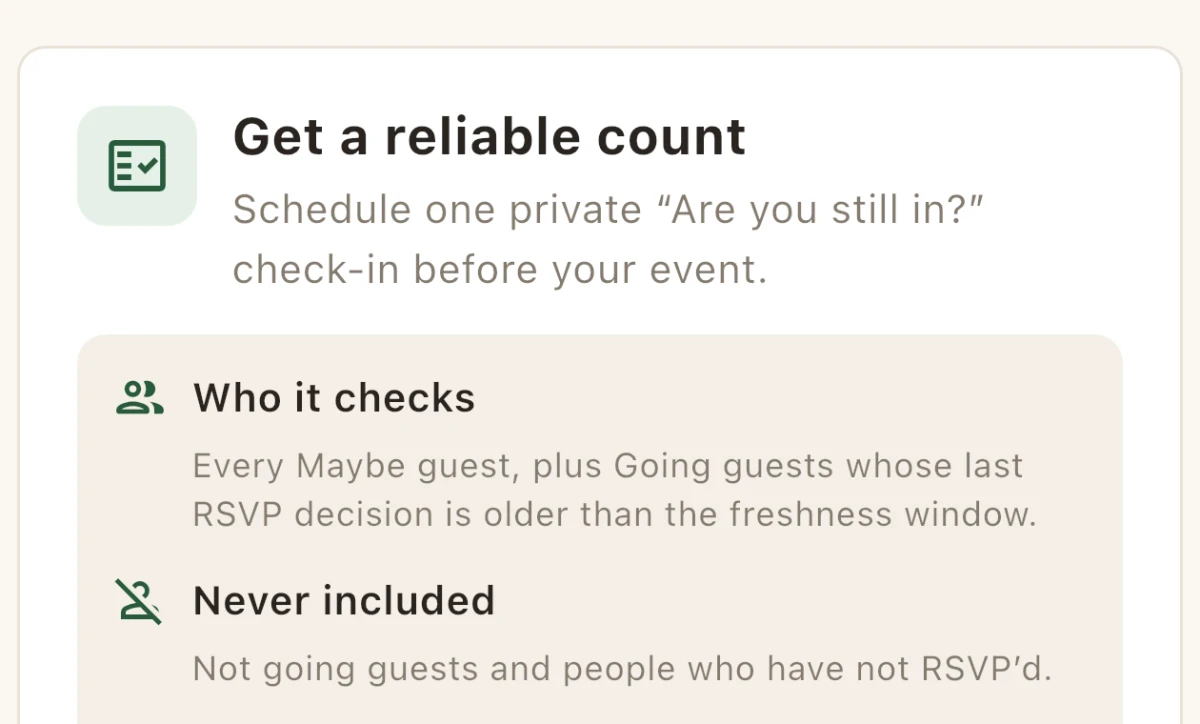
Guests choose:
- I’m committed
- Still uncertain
- Release my place
Their private RSVP is updated to Going, Maybe, or Not going, respectively, giving the host a fresher count without scoring, ranking, or publicly labeling anyone as unreliable.
There is an important limit. Reliable Count can only be delivered automatically through a Madali push notification that the guest already enabled. Madali does not send SMS, and scheduled Circle email is a separate flow for future occurrence invitations—not a Reliable Count email blast. Browser-only guests and guests with push off need a manual follow-up using the same simple wording above.
The useful idea works with or without an app: ask once early, ask once again when the number matters, and make it easy for someone to answer honestly.
If you are still trying to get the first answers, start with how to get people to actually RSVP.
Keep the plan and guest count in one place.
Madali is available for iPhone and Android. Guests reply in their browser.