How to change the time of a party without losing half your guests
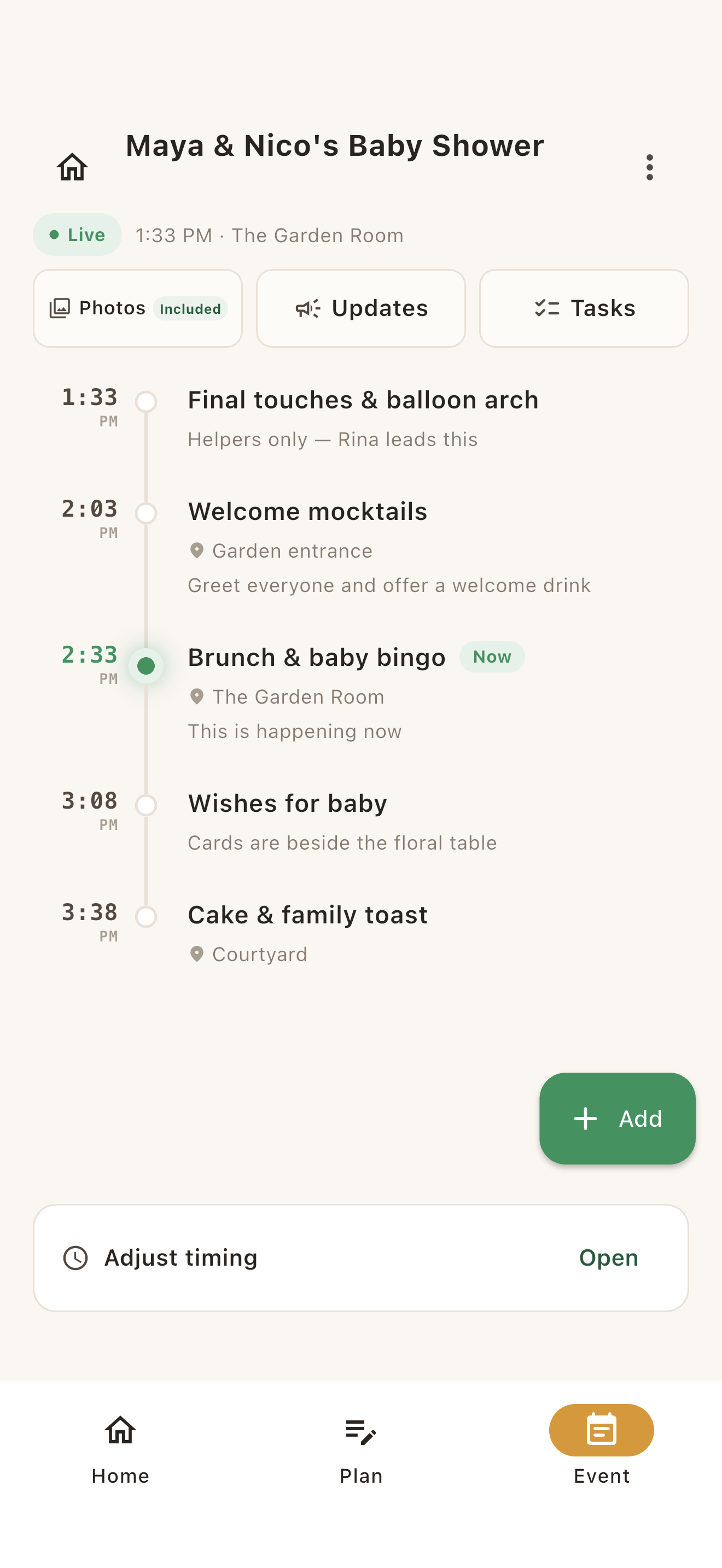
The short answer: say it once, in a message that leads with the new detail rather than the apology, ask everyone who already said yes to confirm again, and make sure the invitation people open now shows the new plan and not the old one.
Changes do not cost you guests. Ambiguity does. When two versions of the plan are both technically available, half the people are working from the wrong one and nobody knows which half.
What actually goes wrong
The old time is still in the thread. You posted the original details on the 3rd. You posted the change on the 11th. Both messages are still there, and the one with all the enthusiastic replies underneath it is the wrong one. Someone scrolls up to check the time and finds it.
The apology buried the information. A message that opens with “so sorry everyone, I feel terrible about this, my sister’s flight got moved and the caterer said” has the new time somewhere in the fourth line. People skim. They see an apology, feel reassured that you have it handled, and never absorb the number.
Nobody re-answered. You have 24 yeses. Those 24 people said yes to Saturday at 6. Four of them cannot do Saturday at 8, and unless you ask, you will find out when they do not arrive. Your count is now confidently wrong, which is worse than not having one.
It happened twice. One move is fine. Two moves and people stop putting it in their calendar, because the calendar entry has already been wrong once.
The method
1. Decide once, then move once
The single biggest thing you can do is not move it again. If the change is because you are waiting on something, wait until that thing is settled before you announce anything. A tentative change is worse than no change, because it teaches people not to trust the details.
2. Lead with the new detail
The first line of the message is the new time. Not the apology, not the reason. Somebody reading only the first line should come away with the correct information.
Apologise afterwards, briefly, once.
3. Say it in one place, and update the thing people open
If the invitation lives at a link, update the link. If it does not, the change message becomes the only correct source and it will get buried within a day.
This is the part most people skip and it is the part that costs guests. Whatever people open when they check the details has to show the new plan, because that is what they will look at on the day, not your message from nine days ago.
4. Ask everyone who said yes to say yes again
Explicitly. Not “let me know if you can no longer make it,” which reads as optional and produces almost nothing. Ask for the confirmation as a small, clearly stated task.
The reason to be direct is that you need a number, and a stale yes is not one. People are not offended by being asked to confirm. They are relieved that somebody is keeping track.
5. Give people an easy exit
Some people genuinely cannot do the new time. Make saying so cost nothing, or they will disappear rather than write the explanation they think you want.
Messages you can copy
Time change:
Update: Saturday is now 8pm, not 6pm. Same place, everything else the same. Sorry for the switch. Can everyone give me a quick yes or no for the new time, even if you already answered? I need the count for food.
Date change:
Emma’s party has moved to Sunday the 22nd, 4pm. Same place. Hopefully that works for most of you, and completely fine if it does not. Please answer again for the new date so I have a real number.
Venue change:
Same day, same time, new place: 14 Grove Street, not the park. Rain. Parking is easier there, on the street. Nothing else changes.
Something moved and you do not yet know where it lands:
Heads up: Saturday may move, I will know for certain by Thursday. Do not change anything yet, I will send one message with the final plan.
That last one is worth having in your pocket. A short warning followed by one final answer keeps people’s trust. Three tentative updates do not.
How much notice matters
Rough guidance, and yours will vary with how close your group is.
- More than two weeks out: a move costs you almost nobody. Send it and move on.
- Three to fourteen days: expect to lose some people, particularly to anything involving childcare or travel. Ask for a re-confirm and take the new number seriously.
- Under 72 hours: message individually. A group message is not enough at this range, because the people who will not see it in time are exactly the people who will show up at the wrong hour.
- Same day: phone the people whose absence would matter. Do not rely on a message being read.
When somebody cannot make the new time
Say the short, generous thing and then let it go.
No problem at all, we will catch up properly soon.
Do not negotiate, do not ask them to try, and do not move it a second time to accommodate one person. Moving twice loses more people than the one you were trying to keep.
The thing to fix before the next one
Almost all of this pain traces to one structural problem: the details live in a stream of messages, and a stream does not have a current version. The fix is not a better message. It is having one place people open that is always right, so a change is an edit rather than an announcement that has to outrun the scroll.
Where Madali fits
Madali is built around exactly this.
The plan lives at a link. Change the time or the place and the link shows the new details straight away, so anybody who opens it gets the current answer rather than a message from Tuesday. And the people who already said they were coming are asked to confirm again, because a yes to the old time is not a yes to the new one. Your count reflects the plan you actually have.
The honest limit: for a one-time gathering or a changed plan, you still tell people yourself. Madali makes the links and you share them in the group chat or wherever you already talk. Madali does not send SMS. Optional scheduled Circle email is for future occurrence invitations, not a general plan-change blast. What Madali guarantees is that when guests look, what they find is right.
Free covers one celebration at a time, with the full timeline, guest list, and invitations. Madali is available on the App Store and Google Play.
Before the change, there is a related problem worth solving: getting people to answer in the first place.